
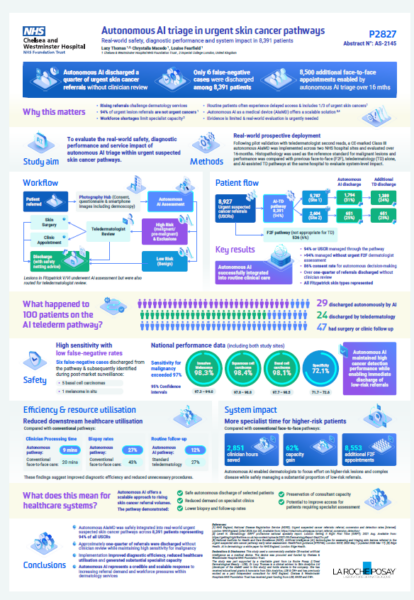
Research and evaluation by Chelsea and Westminster Hospital NHS Foundation Trusts finds that Skin Analytics’ AI medical device DERM safely discharges over a quarter of urgent skin cancer referrals without a face-to-face appointment and offers a 62% gain in clinical capacity.
New research from Chelsea and Westminster Hospital has found that Skin Analytics’ DERM technology, the AI medical device for skin cancer detection, frees up thousands of NHS dermatology appointments every year by discharging benign cases at the first appointment in the first large-scale, long term medical evaluation for an autonomous AI deployed within a cancer pathway.
Urgent suspected skin cancer referrals in England have almost tripled since 2009, yet only around 6% result in an urgent skin cancer diagnosis [1]. At the same time, approximately one in four dermatologist roles in the UK is unfilled, creating a growing mismatch between demand and specialist capacity [2].
DERM, the only CE-marked Class III AI as a medical device, was introduced at Chelsea and Westminster Hospital NHS Foundation Trust to help bridge this gap, following an initial validation period. Using clinical and dermoscopic images captured on a smartphone, DERM was used as a first review for skin cancer referrals, classifying lesions and autonomously discharging non-cancerous cases, while referring higher risk cases for teledermatologist review. Over 16 months from December 2024, DERM reviewed 8,391 patients – accounting for 94% of urgent skin cancer referrals across the Trust.
The Chelsea and Westminster project also showed a reduction in biopsy rates compared with conventional face-to-face care, meaning fewer worries for patients and less pressure on the NHS. Biopsy rates reduced to 27% compared with 43% for conventional face-to-face care.
DERM autonomously discharged 31% and 25% of patients at the Trust’s two hospitals without clinician review, while teledermatologists subsequently discharged a further 24% and 25% respectively. Taken together with reduced teledermatology processing time and fewer surgical requests compared with face-to face appointments, DERM was shown to have saved 2,851 hours of clinician time – a gain of 62% in clinical capacity, which could equate to more than 8,500 additional face-to-face dermatology appointments freed up by DERM.
Neil Daly, founder and chief executive of Skin Analytics, said:
“These results show what is possible when hospital trusts implement AI at scale. Every case DERM safely discharges is time given back to a dermatologist, and to a patient who needs it most. The NHS is showing real leadership on how it is using autonomous AI in cancer care, and this new Chelsea and Westminster data adds compelling weight to the case for adoption.”
Dr Lucy Thomas, lead author and consultant dermatologist at Chelsea and Westminster Hospital NHS Foundation Trust, said:
“We believe the greatest value of autonomous AI lies not in the technology itself, but in the specialist capacity it unlocks. Every hour saved reviewing low-risk lesions can be reinvested in patients with skin cancer, helping them access timely treatment and improving prognosis, or in patients with severe inflammatory skin disease, where earlier access to specialist care and effective treatments can transform quality of life.”
DERM has previously been shown to identify skin cancers at the level of a dermatologist, with recent nationwide monitoring from the manufacturer demonstrating DERM has correctly identified 98% of the skin cancers that presented. It’s already in use in more than 25 NHS Trusts in the UK and has assessed more than 250,000 patients and identified more than 25,000 cancers.
“If these findings are replicated across larger populations and different healthcare settings, autonomous AI could become an important part of creating a more sustainable dermatology service – not by replacing dermatologists, but by allowing scarce specialist expertise to be focused where it can make the greatest difference to patients’ lives,” Dr Thomas concluded.
The findings are believed to be the largest review of autonomous AI use in NHS cancer pathways and were presented at the European Academy of Dermatology and Venereology (EADV) Congress 2026. The study was partly supported by a grant from La Roche-Posay (L’Oreal Dermatological Beauty).
References:
- Thomas, L., Macedo, C., Fearfield, L. (2026, September 30 – October 3). Autonomous AI triage in urgent skin cancer pathways: Real-world safety, diagnostic performance and system impact in 8,391 patients. EADV Congress 2026, Vienna, Austria.
- Mitra, A., van Bodegraven, B., Venables, Z.C. (2026). P206 Conversion rates for urgent suspected skin cancer referrals in England 2009–2023. British Journal of Dermatology. 2026;195(Suppl 1). doi:10.1093/bjd/ljag086.233.
- Levell, N. (2021). Dermatology GIRFT Programme National Specialty Report. GIRFT, NHS England. Available at: https://gettingitrightfirsttime.co.uk/medical_specialties/dermatology/